

How To Add Lines To A Google Sheets Template
How to Make a Line Graph in Google Sheets – Video tutorial:
Zero conveys and represents information as clearly as a line graph.
From statistics to evolving data, line graphs are a sure manner to record and monitor advisory changes accurately.
With the use of line graphs, trends conspicuously appear, assuasive individuals and companies alike to suit their operational procedures to achieve their overall goals and objectives.
Permit usa explore line graphs in more detail, and discover how to brand a line graph in Google She
Overview of Line Graphs
Line graphs have straight, solid lines connecting solid, data points called "markers", and display the line segments chronologically.
Line graphs accept an "x-axis" (or horizontal centrality) and a "y-axis" (or a vertical axis), which differentiate between the categories and the measurement values, respectively.
For example, if a company wants to compare their revenue between 2018 and 2019, a line graph would exist the best fashion to display the information and detect the trends.
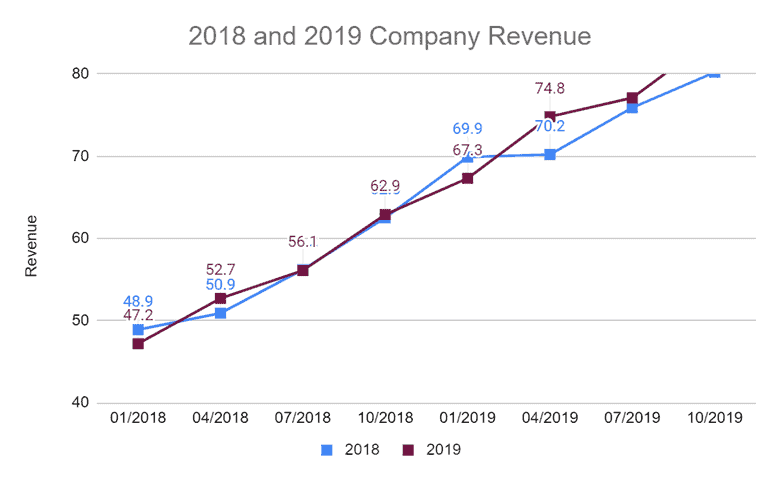
But before an constructive and efficient line graph is created, it's important to know what the essential parts of a line graph are. By understanding the different parts of a line graph, information can be displayed in the style it is meant to be conveyed.
So, permit'southward examine the dissimilar parts of a Google Sheets line graph, and and then notice the steps to create one!
Important Parts of a Line Graph
The of import parts of a line graph include:
- Y-Centrality (vertical axis)
- X-Axis (horizontal axis)
- Chart Title
- Markers
- Grid
- Y-Centrality Label
- X-Centrality Label
- Legend
Purpose of Line Graphs
Simply what exactly is a line graph? A line graph is a graph that displays the relationship between two or more than changing quantities over time. Yet, a line graph can also brandish only ane changing quantity if in that location is aught to compare it to.
The best time to utilise a line graph is when you need to demonstrate trends, changes, increases, decreases, etc. A line graph is more intuitive to show irresolute and evolving trends than other types of graphs.
Cheque too other ways how to track changes in Google Sheets.
Line graphs are best used for:
- Showing evolving data
- Showing how two continuous variables relate to one another
And so, allow's swoop right in and starting time creating a Google Sheets line graph.
How to Make a Line Graph in Google Sheets
Beneath are the steps to brand a line chart in Google Sheets
Pace 1: Enter data in Google Sheets.
This is the almost important step because what yous enter in your Google Sheets spreadsheet is what will be conveyed in your line graph.
Below is the entered data for the example in a higher place. Find how cell A1 is empty.
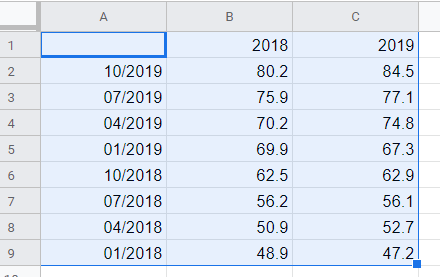
If you lot are creating a multiline graph, cell A1 will e'er exist empty.
Step ii: Highlight the data, and click on the chart icon.
Select the entire dataset for which you want to insert the line nautical chart and then click on the chart icon in the toolbar.

You can also do the same by going to the Insert pick on the menu and and so clicking on the Nautical chart option.
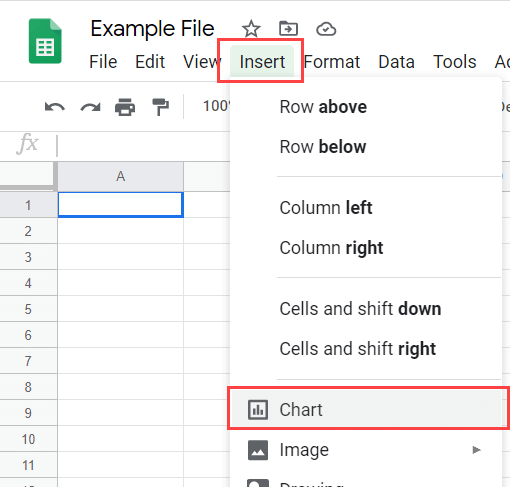
Notwithstanding, nigh of the time, Google will make up one's mind the entered data is appropriate for a line graph, and will automatically populate ane for y'all and then you don't have to select information technology.
In case it doesn't,
- Click on the nautical chart
- Click on the iii dots that appear on the top-correct part of the chart,
- Click on Edit chart
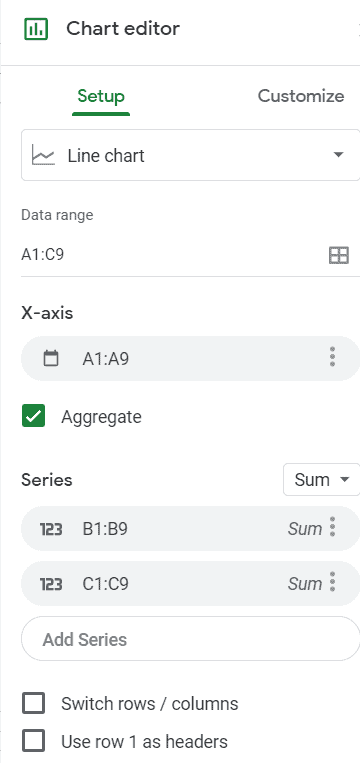
This volition open up the 'Chart editor' pane on the right. You can modify the chart type from the 'Chart blazon' options (and select a line chart if that has not already been inserted)
Once you have the line chart in the worksheet, yous can now fine-tune the chart using the Nautical chart Editor.
Pace 3: Choosing the Right Nautical chart Blazon Settings
In the Chart editor, you get admission to a number of 'Nautical chart type' setting options.
This showtime dropdown box under "setup" allows yous to select the type of graph you want to use. The iii options include:
-
- Regular Line chart
- Smooth line chart
- Combo line chart
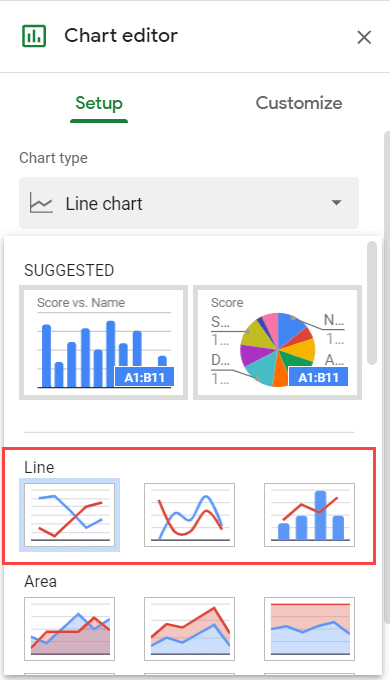
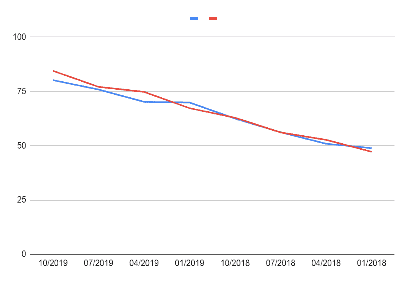
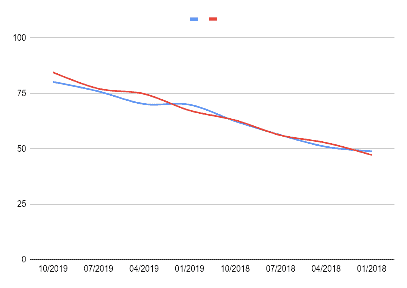
The difference between the three options is shown below.
The image below is of a regular line chart
The image beneath is of a polish line chart
The prototype beneath is of a Philharmonic line nautical chart
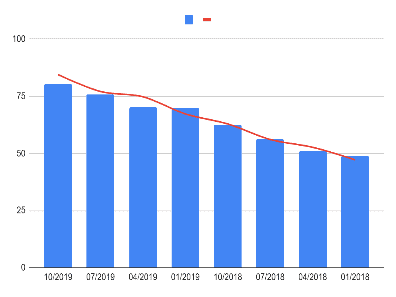
A regular line graph volition accept a more jagged appearance, while a smooth line graph volition have flowing lines. A combo line graph volition combine a line graph with a bar graph. While the selection for how yous desire your graph to appear is yours, the most popular selection is the regular line graph as the data is displayed more straight and precisely.
Note that the combo line chart only makes sense when y'all take two series of data.
Below are another options you have in the Chart setup pane:
- Information range: This is the range of cells you highlighted from your spreadsheet to create your chart.
- X-Centrality : This is the range of cells from your spreadsheet that make upward your chart's X-Axis.
- Aggregate: When the aggregate box is checked, it allows you lot to aggregate all values that share an identical X-Axis key. For your series or lines, the aggregate dropdown box will give you the choice of displaying the information's:
- Average
- Count
- Max
- Median
- Min
- Sum
- Aggregate: When the aggregate box is checked, it allows you lot to aggregate all values that share an identical X-Axis key. For your series or lines, the aggregate dropdown box will give you the choice of displaying the information's:
- Series : Each line represented in your chart is called a "serial". The three dots at the terminate of the series bar give y'all the option to add together labels or remove them.
- Switch Rows/Columns box : When checked, this volition modify your Ten-Axis data to the Y-Axis, and vice versa.
- Utilise Row 1 every bit Headers: By checking this box, you're using the labels from row one of your spreadsheets and creating a legend for your chart.
Step 4: Doing some Nautical chart Customization
In the chart editor side by side to the right of the setup tab is the customization tab. This tab will allow you to customize the:
- Nautical chart style
- Chart and axis titles
- Serial
- Legend
- Horizontal Axis
- Vertical Axis
- Gridlines
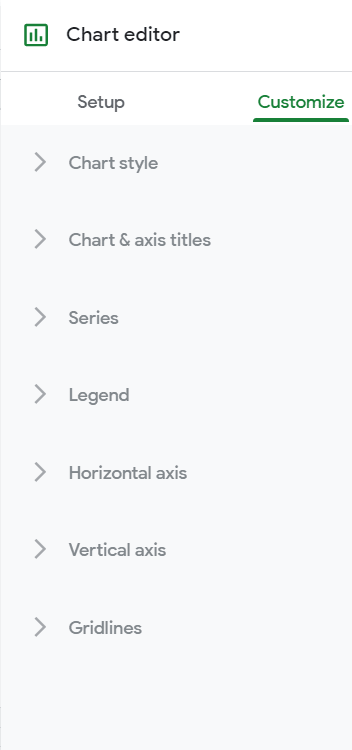
From font fashion to font size and from alignment to color, the customization tab truly allows you to make your chart your own.
- Chart Style: Nether this section, you're given the opportunity to change the background color of your nautical chart, as well as the chart'southward edge colour and font. Y'all tin can make up one's mind if you want your chart to take shine lines, a maximized view, plotted nix values, or a compare mode layout.
- Nautical chart & Axis Titles: Every nautical chart needs a title so the audience knows what information they're looking at. The chart and centrality title section allows you lot to not only give your chart and each centrality a title, merely change the font style, font size, format, alignment, and color likewise.
- Series: Here you can customize the style of your lines. By adjusting each line's thickness, the marker point size, and the marker point shape, yous can create the chart that most clearly displays the information you want to convey. In this section, the aggregate dropdown carte allows you to select the type of aggregate yous want your chart to brandish. You lot can even customize a specific marker on your nautical chart under "format information point" 🡪 "add". You tin even select to display features such as mistake bars, data labels, and trendlines.
- Fable: This card allows you to position your legend in your desired spot, as well as change the fable's font, size, format, and text colour. Read the total guide on how to label legends.
- Horizontal Axis: Like the customization options above, the horizontal centrality menu gives y'all the opportunity to change the label font, label font size, label format, and text color. Ii boxes nether this department too allow yous to modify your chart by creating labels as text and reversing axis order.
- Vertical Centrality: In one case again, with a choice of font, font size, format, and color, this menu option has 2 bare boxes to enter a minimum and maximum values for the Y-Centrality. You tin can bank check the box "treat labels as text", as well every bit modify the scale factor to include punctuation in your values. If you wish, you tin customize the vertical axis by checking the "log scale" box, every bit well every bit alter the number format by selecting your desired style from the corresponding dropdown menu.
- Gridlines: Gridlines can be helpful when displaying data. They provide a perspective that helps an audition better understand and comprehend the data provided. By selecting the major and small gridline count, as well as the major and modest gridline colors, charts certainly come up to life as does the information they display.
And then this is how to make a line ch in Google Sheets. Nosotros hope this tutorial has helped you lot larn exactly how to make a line graph easily in any Google Sail y'all may exist working on.

Sumit
Google Sheets and Microsoft Excel Expert.

How To Add Lines To A Google Sheets Template,
Source: https://productivityspot.com/line-chart-google-sheets/
Posted by: torresthereenewhe.blogspot.com
0 Response to "How To Add Lines To A Google Sheets Template"
Post a Comment