

Tamron 18 270 Vc Pzd Test
Page 2 of 3
Baloney
Super zoom lenses usually show quite pronounced image distortion and the Tamron 18-270 VC PZD is no exception in this regard. At the shortest setting there is very pronounced barrel baloney of just below 4%. When zooming in, the type of distortion soon flips over to the pincushion kind. At 35mm, it's already quite pronounced and reaches a maximum of more than 2.i% at 80mm. Zooming in further, the amount of baloney decreases a little, but remains on a rather high level, even for a super zoom.
| |||||||||
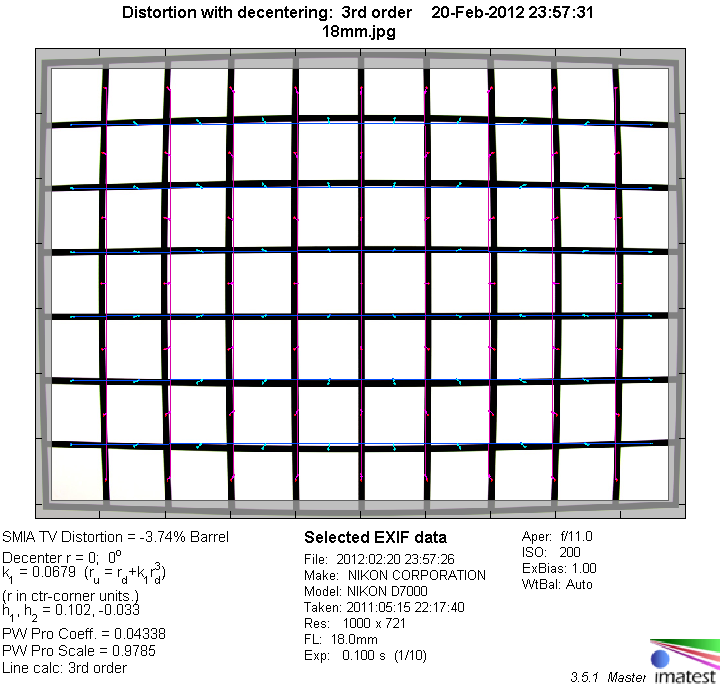 | |||||||||
The chart to a higher place has a real-globe size of near 120x80cm.
The 2 images beneath, shot at 18mm and 35mm, give an impression of the impact of high baloney on real-world subjects.


Vignetting
Vignetting is quite well controlled at medium focal lengths, but more pronounced at the shortest zoom setting and besides from 130mm onwards. As usual, stopping downward helps to subtract the amount of light fall-off. 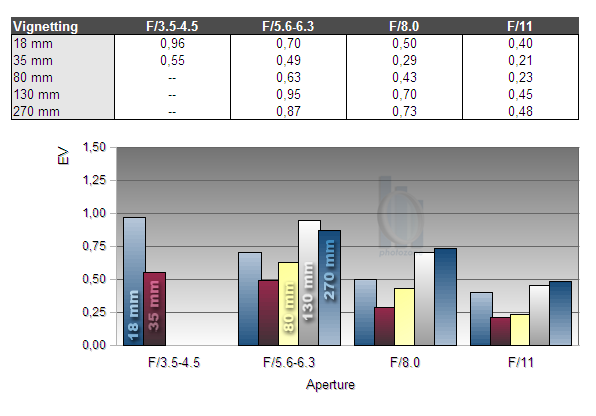
MTF (resolution)
In the prototype center, the lens delivers generally very good resolution at all tested focal lengths and apertures, reaching fifty-fifty excellent resolution at 18mm when stopped down.The borders and corners are a different story, though. Throughout almost of the zoom range the resolution is quite depression hither at large aperture settings. In the lower zoom range the sharpness can be increased here past stopping downwards. The all-time functioning is shown at the shortest focal length again.
Towards the longer focal lengths however the edge and corner resolution remains on a rather low level, even stopped down.
Please note that the MTF results are non directly comparable beyond the different systems! Below is a simplified summary of the formal findings. The chart shows line widths per picture height (LW/PH) which tin can exist taken as a measure for sharpness. If yous want to know more most the MTF50 figures yous may check out the corresponding Imatest Explanations

Chromatic Aberrations (CAs)
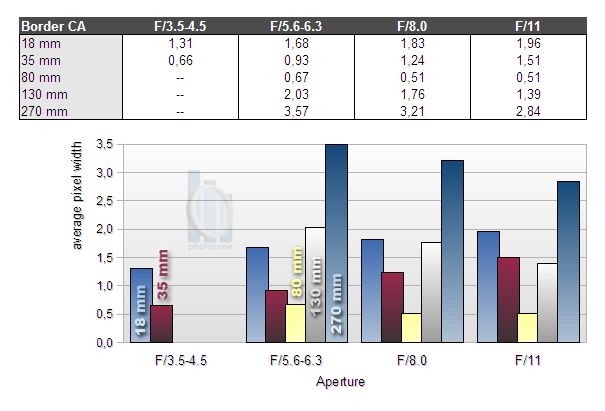
CAs (colour shadows at harsh contrast transitions) are well controlled at medium focal lengths. At 18mm and 130mm they are more pronounced and reach very high values at the longest focal length setting of 270mm.However, CAs can easily be corrected in software or by the camera itself (nigh modern Nikon DSLRs remove CAs themselves if you shoot JPGs).
Bokeh
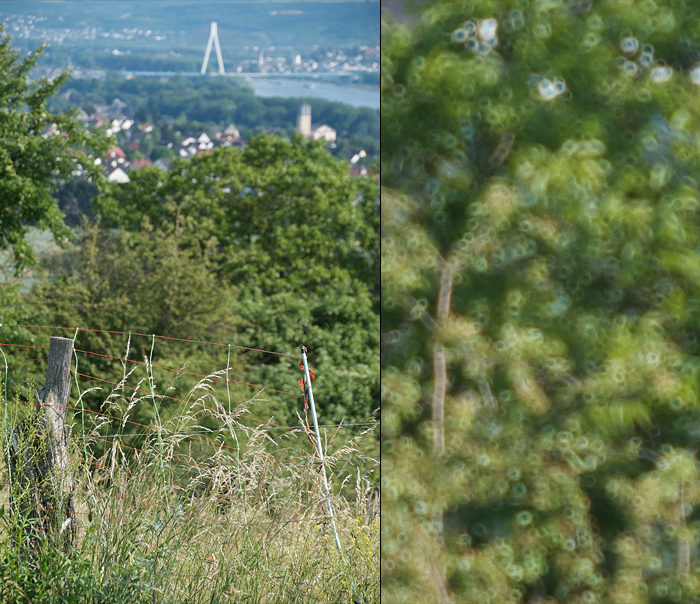
A tiresome lens like the 18-270 PZD is certainly not the first choice to split up the master bailiwick from the groundwork. Merely fifty-fifty with a maximum discontinuity down to as low as f/six.3 it'due south all the same possible to blur the groundwork, especially with longer focal lengths or large discipline to background distances.We exercise not formally exam the quality of background blur for such slow lenses, simply feel the demand to illustrate if a lens shows extraordinarily expert or bad behaviour in this regard in our field tests. The Tamron 18-270 PZD unfortunately qualifies for a non-honorable mention.
For focal lengths in the upper range (roughly from 130 mm upwards) the bokeh quality is non stellar and certainly a fleck on the rough side, but still acceptable. Below however the bokeh can be very nervous and distracting:
Source: https://www.opticallimits.com/nikon--nikkor-aps-c-lens-tests/716-tamron182703563pzd?start=1
Posted by: torresthereenewhe.blogspot.com
0 Response to "Tamron 18 270 Vc Pzd Test"
Post a Comment