

How To Save Asana Templates To Google Drive
Asana has quite a few features aimed at making it as like shooting fish in a barrel to employ equally possible. One of those features is the availability of templates. Rather than staring at a bare screen, a user can deploy a template that provides a framework for starting to manage a project.
What Are Asana Templates Anyway?
A software template is a document that has some aspects pre-built for the cease-user. The template provides a starting point or a framework, which is especially helpful for beginners who are unsure where to beginning. Those in a bustle tin besides benefit from the headstart a template provides.
Templates are common for many types of software, including discussion processors, spreadsheets, presentations, and emails.
Projection management software like Asana also routinely makes use of templates.
Call up of an Asana template as a time-saving tool. Rather than starting from scratch every fourth dimension a user wants to build a programme for managing a product, relying on a template allows the user to focus on the details of tracking the projection. The template handles the basic layout of the information.
Types of Asana Templates
One of the biggest benefits of the templates in Asana is that they have multiple design variations. Past varying the design just a bit, Asana's designers created templates with features to match specific types of projects.
For instance, a marketing campaign projection would demand a slightly unlike layout and template than a project creating a business organization strategy.
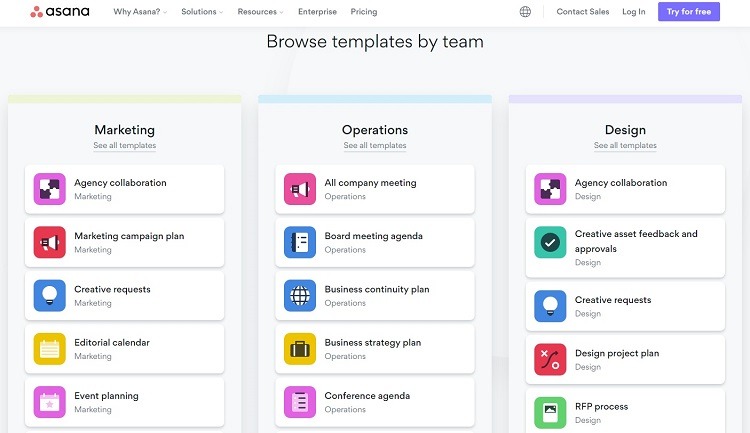
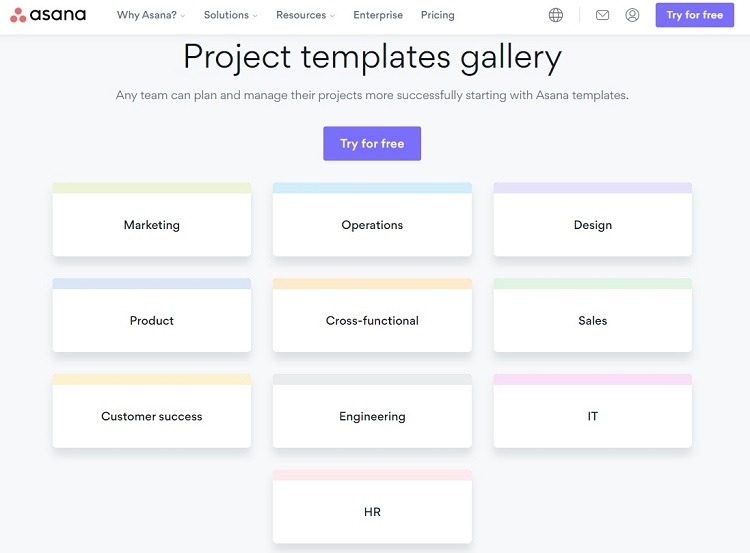
Some of the major groups of templates Asana offers include:
- Cross-functional
- Customer success
- Blueprint
- Engineering
- Homo resources
- Information technology
- Marketing
- Operations
- Product development
- Sales
Asana Pricing
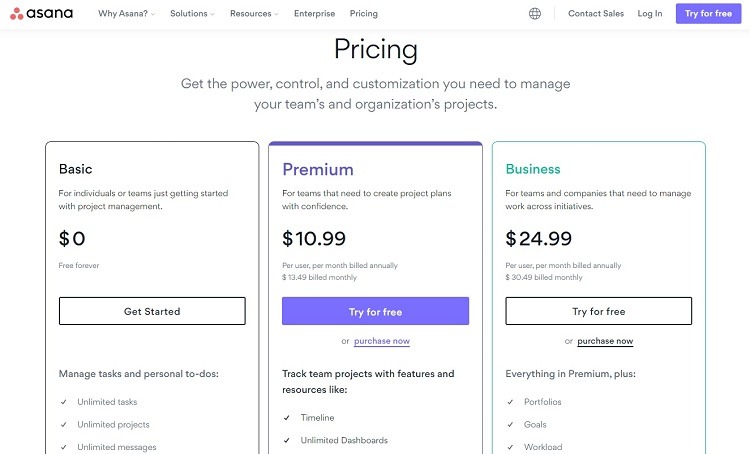
To apply Asana integrations, users volition need to take an business relationship with Asana. Templates are bachelor in the Basic tier. To access the advanced template features in Asana, subscribers will demand to upgrade to a paid tier.
- Basic: The Basic tier is non a gratuitous trial period. Instead, it'southward free to use as long equally the subscriber wants. It carries a limit of 15 people on the account. Inside the complimentary tier, users can access the bones templates built into Asana.
- Premium: The Premium tier starts at $10.99 per month per user when paying annually. When paying by the calendar month, the cost is $13.49 per month per user. This tier has no user limit. It includes all templates available with the free level, and subscribers can access advanced and custom template features.
- Business: Business tier subscribers will pay $24.99 per calendar month per user when paying annually or $30.49 per month per user when paying monthly. The Business tier has the same features as the Premium tier in terms of templates.
- Enterprise: Those interested in the Enterprise tier must contact Asana for a custom toll quote. It has the same template features available in the Business and Premium tiers.
How Asana Templates Work
Making use of templates in Asana helps relieve fourth dimension past eliminating repetitive tasks. Rather than building projects from scratch every time, starting the project with a template gives users a improve starting point for the work.
As another advantage of using templates, team members will be able to comport the same layout from project to project. All of the projects in Asana based on templates will have a like look and flow. This lets team members jump into the project faster without learning new processes or workflows.
With the template, squad members can view the Asana board in a timeline, Kanban, agenda, or list view format. Some types of projects work better in ane view format over another. The timeline view helps team members see deadlines more than clearly, while the Kanban view helps team members come across and track the progress of tasks.
Starting Point
Templates provide the building blocks for projects in Asana. The template can include task cards, cavalcade names, blueprint layouts, descriptions, and file attachments.
Beyond the specific pattern elements in the template, information technology can provide a series of metrics to follow for the team. The template can specify goals, timelines, schedules, budgets, and expected deliverables for the projection. When these types of items are the same from project to project, a template ensures the squad doesn't miss anything. When building a board from scratch, the squad may overlook or forget something important.
Types of Asana Templates
Asana offers both custom and pre-built templates.
- Custom: With a custom template, team members will build a basic project in Asana. They then tin can salve the framework of the project every bit a template to use for futurity projects.
- Pre-built: Asana offers dozens of templates that are part of the software created by their designers. Just select the pre-built template that best fits the projection design from the list and offset using information technology.
We'll discuss some examples of the unlike types of pre-built templates that Asana subscribers can use before discussing how to utilise custom templates.
Example #one: Using Templates for Marketing Projects
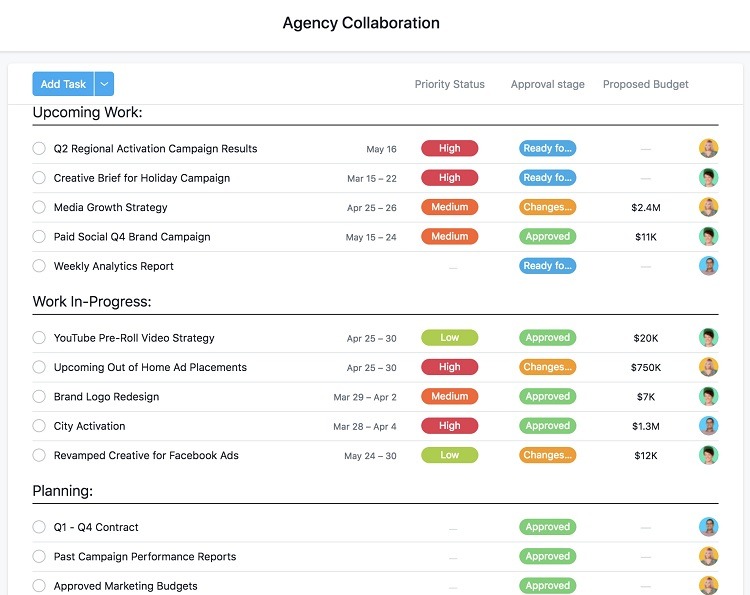
Asana offers more than a dozen templates set up expressly for marketing projects and campaigns. The templates cover all aspects of managing a marketing project, from the conception of ideas to the execution of the project and everything in betwixt.
Without a project management process in place, marketing campaigns can go unwieldy. Rather than relying on text messages and emails to try to rail all of the different aspects of the campaign, storing all of the data in Asana is far more efficient.
Some Asana templates provide a starting signal for working through the creative part of launching a marketing campaign. Others help with executing the actual launch of the campaign, setting up a social media rush, or launching a product. Using templates in Asana helps ensure nil falls through the cracks by tracking all requirements for the project, keeping it on track.
With many marketing projects, it's essential to stay within a budget. Some Asana templates include the power to rail spending, ensuring teams stay on task regarding the spending for the issue.
Case #two: Using Templates for Human being Resources Projects
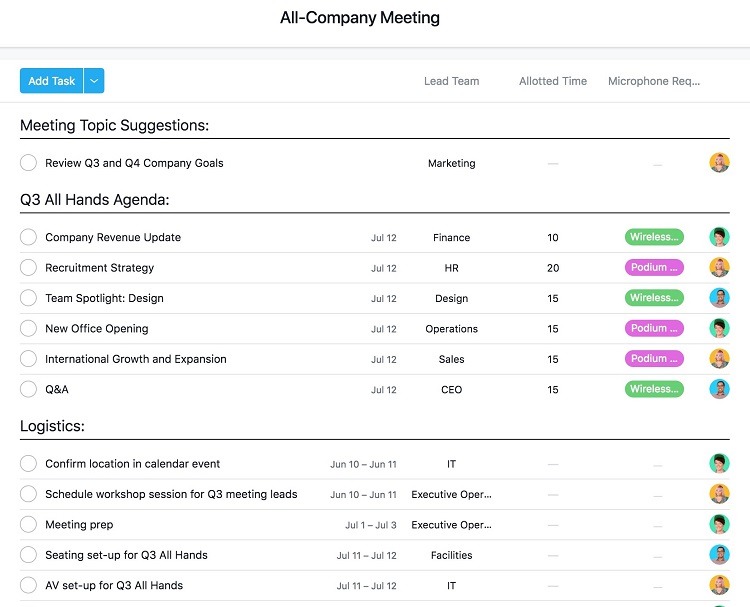
Although many teams focus on using project management software for external projects, internal projects tin also benefit from Asana'due south features. HR departments tin use Asana templates to create steps for tracking their processes.
Asana contains more than a dozen templates made for human resources departments. Some of these templates include a framework for:
- Creating visitor meeting agendas
- Tracking job candidates
- Managing facility requests
- Tracking the employee onboarding procedure
By using a template for everyday tasks, concerns over forgetting key steps no longer exist.
When the squad is preparing for a meeting, squad members can use Asana to bring up agenda items they want to talk over. Or, for teams that struggle to stay on job during a meeting, using an Asana template to designate the allotted time for each agenda particular tin can be helpful. Should a certain attribute of the meeting drag on, the meeting leader can point to the finish fourth dimension for discussing it on the template and motility the meeting forth.
By tracking facility requests through Asana, squad members tin can create activity task cards for bug they discover around the building. This gives direction the ability to meet all potential problems in one place rather than tracking them down through multiple emails.
Example #3: Using Templates for Product Evolution Projects
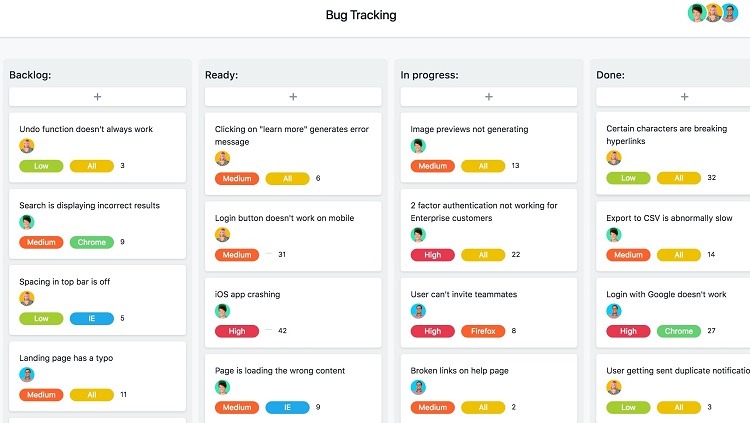
One of the almost popular reasons to brainstorm using projection direction software is to handle product development processes. Whether the squad is creating physical products for auction or is tracking a software production release, templates can make the procedure go smoother.
Asana works specially well for creating a timeline of tasks that demand to exist completed to have the product prepare for release. With several pre-congenital templates available for production evolution within Asana, team members can notice a framework that will fit the blazon of product planned.
Teams can create a template that includes the essential details applicative to all different kinds of product launches. Having the framework within an Asana template ensures that no details regarding a launch are forgotten or disregarded.
Squad members tin then tweak the items inside the template for each launch, ensuring that they fit the exact parameters of a specific project. Calculation specifications, photographs, and drawings to the template ensures that all items team members need are available in one location.
Templates in project management software besides piece of work extremely well for software and app development. Many development projects work in a dart atmosphere. During a sprint, the team will focus entirely on the app, trying to consummate the process as quickly equally possible.
Using a template for a sprint allows the team to accept a framework for deadlines. Because of the condensed timeline, the sprint process moves along quickly. Sometimes, it spirals out of control with tangents and offshoots that don't move toward the final blueprint considering of the speed.
The template helps keep things on task. Concerns over skipping steps during the frenzy of the sprint are non an issue when deploying the template. Having a structure in a template proven to work with past sprint projects volition give the team conviction that they'll reach the desired outcome.
Post-Product Development
Asana templates can help with the postal service-production evolution procedure, likewise.
For instance, software developers may need to track bugs subsequently the product release. Asana offers a bug tracking template that provides a trustworthy project board to cover the primary steps typically involved in problems tracking. This allows the team to focus on things like:
- Sorting the most important bugs to prepare first
- Assigning work to the most qualified team member
- Seeing whether the reported bugs accept a discernible blueprint
- Setting a goal for the release of a new version with the issues fixes in place
How to Go Started With Asana Templates
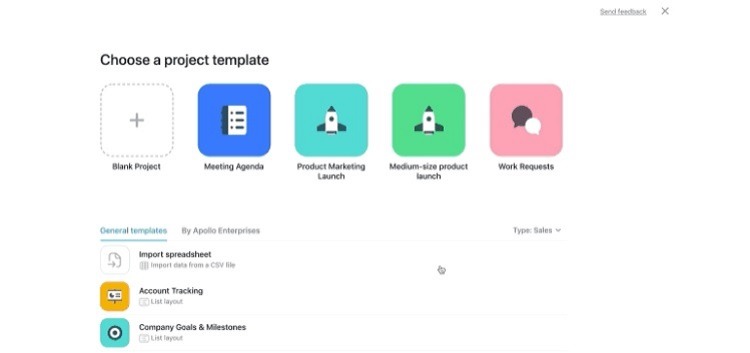
When subscribing to a paid tier of Asana, users can access the app's custom template characteristic. Using a custom template allows y'all to create a template that fits a unique use case. The organization then tin can reuse that template as often as it likes.
The custom template should comprise full general data that volition carry over from projection to project. The template doesn't demand to have specific details that may only fit a couple of projects.
The idea is to give team members the basic framework in the custom template. They then can salvage time by not having to enter data that repeats within each project. Like with pre-built templates, users can edit the custom template to add together information that will be unique to a particular project.
Here are some of the steps required to prepare and use a custom template in Asana.
Stride 1: Set up to Create the Template
Before creating the template, think about what it should contain.
The template should go far easier for the team to work through and consummate tasks for a standard project. Think about the columns that the project requires. If the template should have a series of task cards that are the same for every project, include those.
Every bit part of the template, include all of the essential information and items that deport over from project to project. These may consist of specific files or a listing of directions, for case. Team members can tweak the information in the template to fit the detail needs of a project.
Pace 2: Kickoff a New Projection
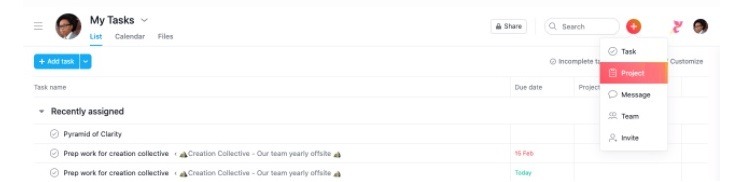
It'due south easiest to create a custom template when starting with a new, blank project. First, y'all'll add in the columns and task cards that should be part of the template.
You tin also create tasks with projected due dates and file attachments for the template. When a team member assigns a new due date range to the projection afterwards, the template's due dates will adjust to fit the range.
Step three: Convert the Projection to a Template
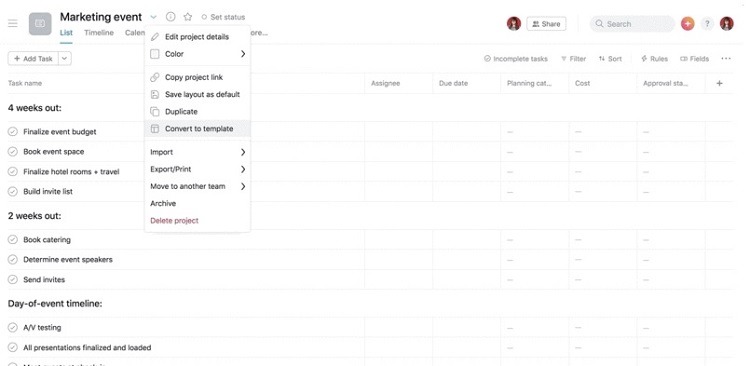
Once the project has all of the general information on it, information technology's time to create the custom template.
Click on the projection's name in the upper left corner of the Asana window to find the Catechumen to Template command. Asana will automatically save the template, making it fix to use afterwards.
Exercise not archive this project or delete it, equally this volition crusade the template to disappear.
Step 4: Call back the Template Later
When information technology'south time to use the template afterwards, open the New Project window. Click on the plus (+) icon in the upper right corner and select Project from the menu.
Step 5: Tweak the Template
Inside the New Project window, click on the Employ a Template push. Gyre through the list of templates until y'all see the arrangement's proper noun. Then select the custom template to use.
Give the template a name for the current project and salve it. Users can then make changes to the new projection board equally desired to fit the exact projection parameters without affecting the original template.
Ideally, they should not have to make many changes, as the template should have a large corporeality of the bones information required to start working. Some editing changes will almost certainly exist part of creating a new project board from a custom template. Merely the idea of making the template is to limit the required changes as much every bit possible.

How To Save Asana Templates To Google Drive,
Source: https://nira.com/asana-templates/
Posted by: torresthereenewhe.blogspot.com
0 Response to "How To Save Asana Templates To Google Drive"
Post a Comment