

How To Draw Proper Support And Resistance Zones
Support and Resistance Levels: How to Ascertain Them Properly
Support and resistance are some of the cardinal concepts of technical analysis. They allow spotting the most preferred areas for buying and selling.
There is a well-known joke among traders:
Question: How can I make money in the Forex market?
Answer: Purchase low, sell high.
Merely those who have experience in Forex trading can take the joke, since predicting reversal points on the chart of a currency pair is non as simple as you may retrieve. Technical analysis offers dozens of useful tools to make the chore easier. For example, you tin spot the right time to make a trade if you know how to find support and resistance levels.
This article is all about how to draw support and resistance correctly. Y'all will learn how to identify support and resistance levels and lines, and get tips on how to apply this noesis in Forex trading efficiently.
What are Back up and Resistance Levels?
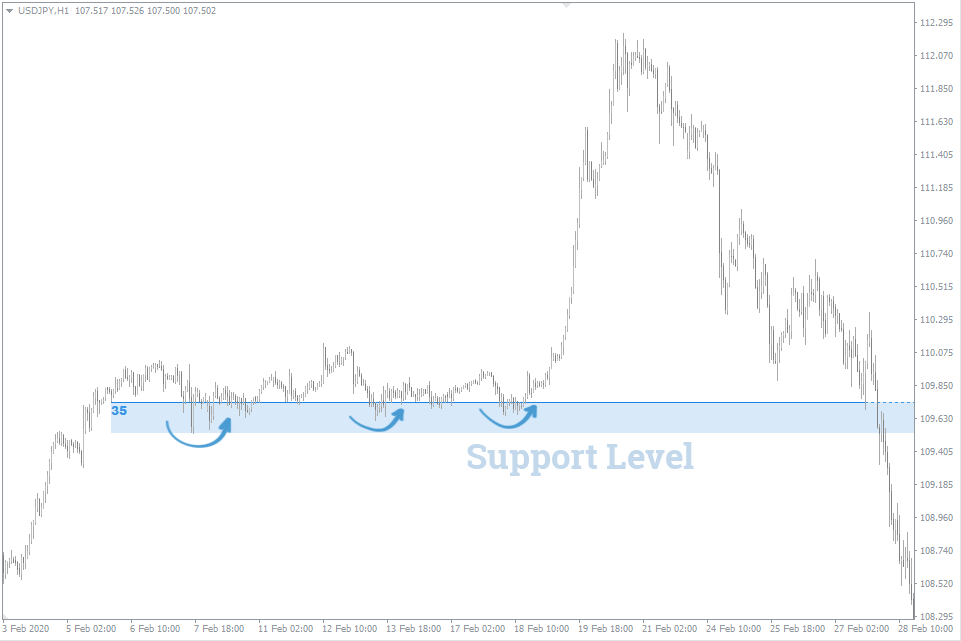
Back up level represents such low nugget prices at which some market place participants no longer want to sell, while others would be willing to purchase.
The psychology of market participants is piece of cake to imagine. Sellers start thinking that information technology is no longer assisting for them to sell a currency pair at current prices. At the same fourth dimension, at that place is a growing number of people willing to buy information technology. Many of them recall the currency pair is undervalued and discover the thought to buy information technology at the electric current low price quite reasonable. As a consequence, buyers are getting more active than sellers, and the price makes a new low on the nautical chart of the currency pair.
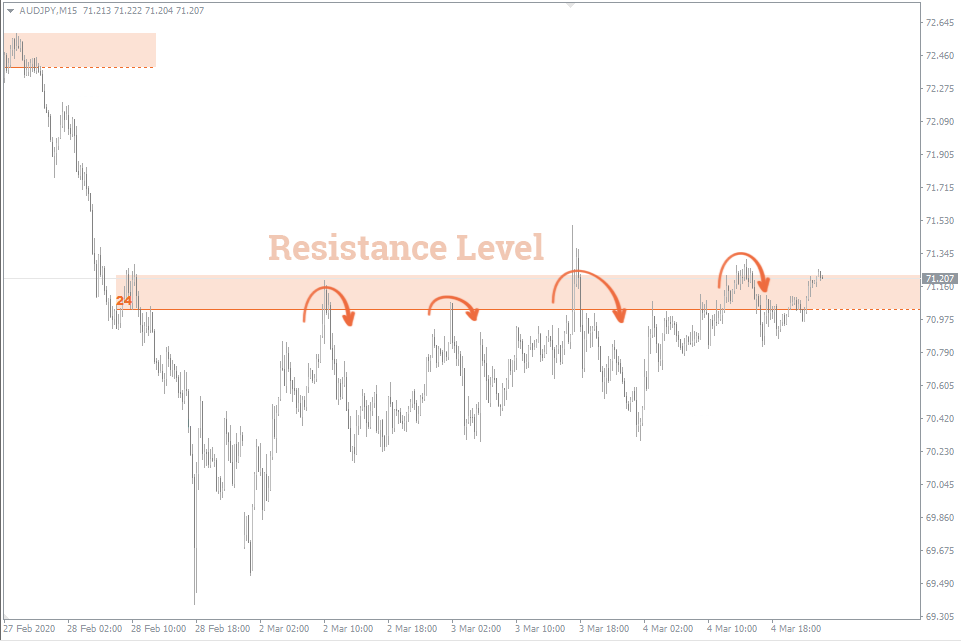
Resistance level represents such high asset prices at which some market participants no longer want to buy, while others would be willing to sell.
Let'due south analyze the market place psychology besides. Buyers commencement thinking that buying this currency pair at current prices involves hazard. On the contrary, there is a growing desire to sell the fiscal musical instrument among sellers. As a result, the pressure of sellers becomes higher than that of buyers. The rise of prices gives style to their autumn, which makes another toll loftier on the currency pair chart.
Why Draw Support and Resistance Levels?
Success in the Forex market place largely depends on the ability to make the right trading decisions.
Various trading methods and algorithms assist with this. Today, there is a large number of them, merely non all are efficient. Fourth dimension-proven strategies using support and resistance levels still show pretty adept results.
The idea behind these strategies is to correctly plot the back up or resistance levels that may affect the movement of a currency pair. You should do this consistently, starting from the higher timeframes upwards to the ane y'all're going to merchandise.
The next steps depend on the behavior of a currency pair at the given moment:
- Uptrend. After breaking out the resistance, you should open a Buy merchandise.
- Downtrend. Later on breaking out the support, you lot should open a Sell merchandise.
- Horizontal range. It's convenient to purchase a currency pair in the lower range zone, and sell it in its upper one.
As yous can see, the underlying idea is simple and logical. Only the hardest matter here is how to actually draw support and resistance levels correctly.
How to Depict Support and Resistance Levels Properly
The following rules will help you lot to calculate strong support and resistance levels.
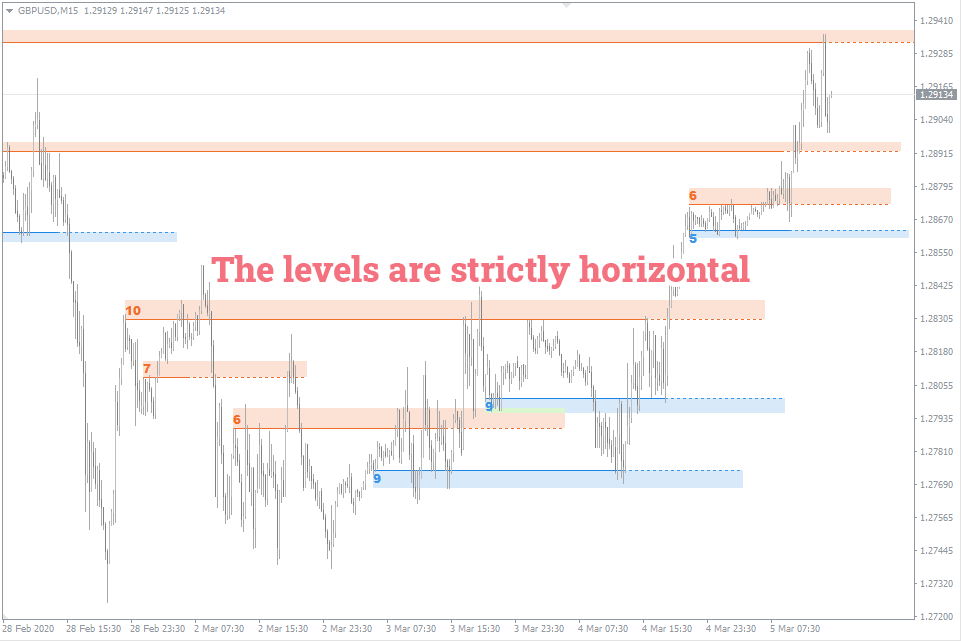
- Support and resistance levels should be in a straight horizontal position.
Don't misfile them with sloping support and resistance lines. We'll talk about them subsequently.
- Take higher timeframes into account.
We mean monthly, weekly, and daily timeframes. Information technology is believed that support and resistance levels are more significant on these timeframes.
If you draw support or resistance levels on the H1 chart, the toll will almost likely take out this level easily on a daily timeframe.
However, if y'all describe support or resistance levels on the daily timeframe, the price with a higher probability will bounciness from this level on the H1 timeframe.
- Plot simply the key levels.
Many traders plot on the chart all the support and resistance levels they're able to discover. This approach makes it very difficult to analyze the market since the resulting picture looks similar "white noise".
Keep in listen that your goal is to spot significant levels, which can cause the cost to bounce from them and create the potential for ownership or selling. That's all that should affair to you.
Of course, a logical question arises: which levels are considered meaning, and which aren't?
There is a universal solution when information technology comes to this: if the price fails to suspension out some level more than once, the level may be considered as a pregnant i. If a certain level holds the price many times, it will nigh likely concord the price force per unit area back in the nearest future.
- Don't go deep into history.
At that place is a common mistake in technical analysis, namely, scrolling back through the time scale of the MT4 trading terminal as well far. It is typical for traders who want to plot all possible levels on the currency pair chart. But, as we have already said, this is non the all-time approach.
Fifty-fifty though scrolling a little back through the time scale is recommended, as this allows for a more than comprehensive assay, don't go too carried away.
It's believed that scrolling back for nearly a couple of years is acceptable for the weekly nautical chart, 6 months is enough for the daily nautical chart, and two months should practice for H1 and H4 charts.
- Don't dwell on the perfect cartoon of levels.
It'southward customary to plot the levels then that they pass through the edges of shadows, i.e., the depression (support level) and the high candlesticks' prices (resistance level).
Simply every experienced trader knows that it'due south almost incommunicable to describe a level so that all toll highs or lows lie in a straight horizontal position.
In fact, the price rarely behaves in such a style that we tin can see conspicuously defined levels. More ofttimes, support and resistance happen to be blurry.
Very often, at that place are situations when you lot need to depict support/resistance levels through a few lows/highs. The level may touch the edges of well-nigh all candlesticks, except for one or two. In some cases, information technology will inevitably pass through the centre of the shadow or even the body of a candlestick. It is acceptable when drawing support and resistance levels.
Support and Resistance Zones
It's more appropriate to identify support and resistance zones rather than the levels. "Zone" is the proper noun for the range that the price has actively interacted with before. In most cases, it's the zones that should be drawn on the chart.
Below is a four-hour GBP/USD chart. You can come across that the price has formed several resistance levels in the upper function of the graph. Information technology's reasonable to combine them into a unmarried resistance zone. Similarly, you tin determine three support levels that should exist combined into a single support zone in the lower part of the chart.
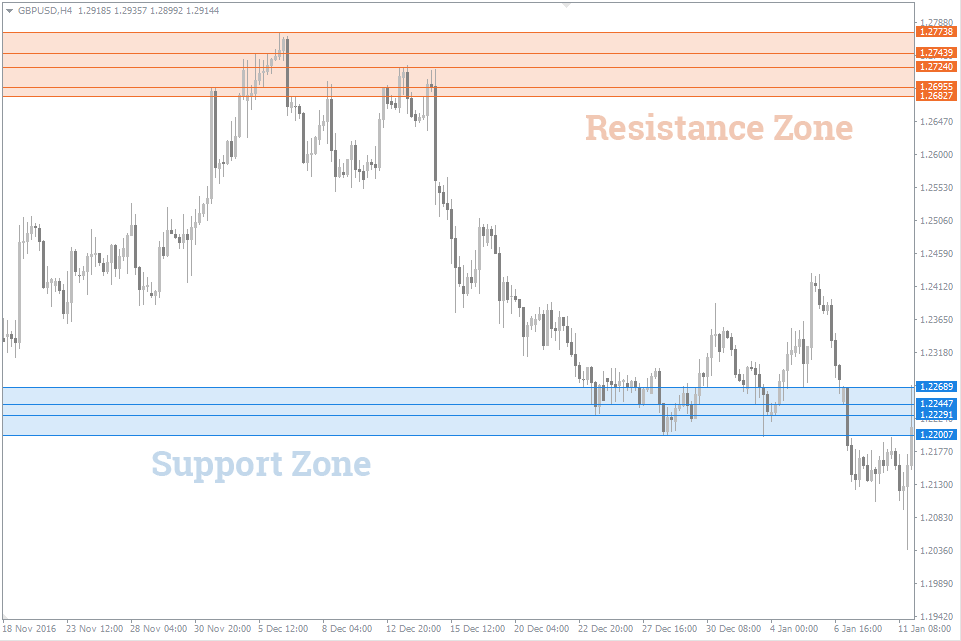
Support and resistance zones better reflect the real market situation. Nonetheless, many traders believe that "zone" is a very vague concept. That'southward why the aforementioned question often arises: what's better to draw – levels or zones? This matter is more of a personal preference. You lot may well use the levels while meaning the zones.
When Support Becomes Resistance and Vice Versa
You lot tin frequently come across the situation when the price breaks out the level, tests it from the reverse side and bounces from it. Equally a result, support becomes resistance, and resistance becomes back up. They phone call them mirror-like levels.
Let's consider the uptrend on the weekly EUR/USD chart equally an instance:
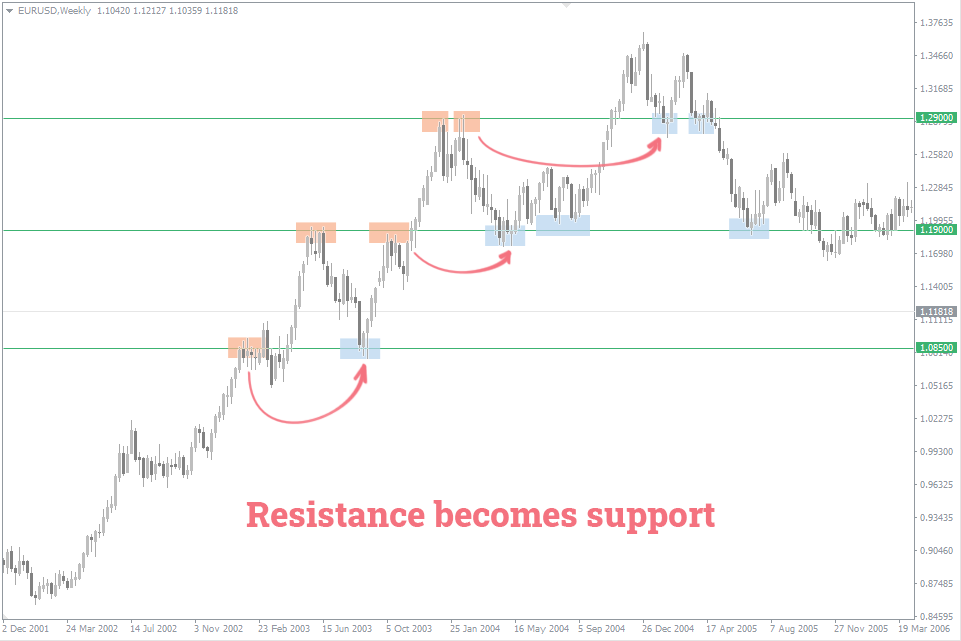
The chart shows that the cost is trading near the resistance level at 1.0857 (see the orange horizontal line on the image). Ultimately, the price is breaking out the level and forming a new resistance at 1.1933 (see the red horizontal line on the prototype). Then it's heading once again towards the 1.0857 level now acting as back up.
Having failed to interruption out the back up, the price is ascent once more, and testing the resistance at 1.1933. After bouncing from the resistance for a while, it does take out this level and makes it a new support.
Then the toll forms the third resistance level at i.2921 (run into the blue horizontal line on the image). Having bounced from it twice, information technology tests the ane.1933 mark a few times. And but afterward, the price breaks out the resistance at one.2921, which later on becomes the new support.
Drawing Support and Resistance Lines
In the previous case, the price is making one high afterward another, thereby converting the old resistance levels into the support levels. However, while testing the broken out resistance, it has almost reached the level. You can oftentimes observe it during a pronounced tendency.
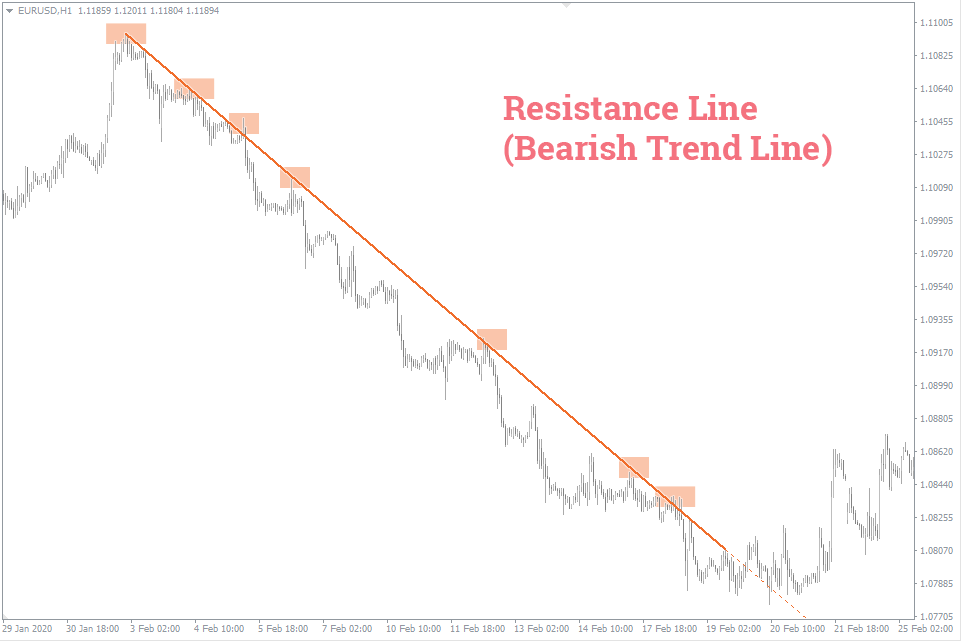
On the weekly EUR/USD chart, each new low is higher than the previous 1. If we connect them, we'll become a so-called back up line. It's the line that the price bounces from during a trend movement. Similarly, you tin can observe the resistance line during a downtrend.
An of import rule of drawing back up and resistance lines is as follows: each line must go through at least ii toll extremes.
If a currency pair shows a steady ascension/fall, it's reasonable to brand a Buy/Sell merchandise without waiting for the price to reach a back up/resistance level. In this case, rely on the support/resistance line.
It's considered that all technical analysis patterns (triangles, flags, pennants, etc.) are only combinations of the support and resistance lines and levels.
How Can I Place Support and Resistance and then That It'southward 100% Accurate?
Drawing support and resistance levels is a very important point that you shouldn't ignore. Information technology's believed that it underlies the entire technical analysis, and it'southward impossible to develop an efficient trading strategy without it.
If levels are not accurate, further analysis will be inaccurate also. Sadly, even professional traders don't ever calculate the levels correctly.
This may result in Cease Out or loss of potential profit. Is there any way to protect oneself against information technology?
To eliminate the man factor, use the Support&Resistance indicator. It plots both levels and zones of support and resistance.
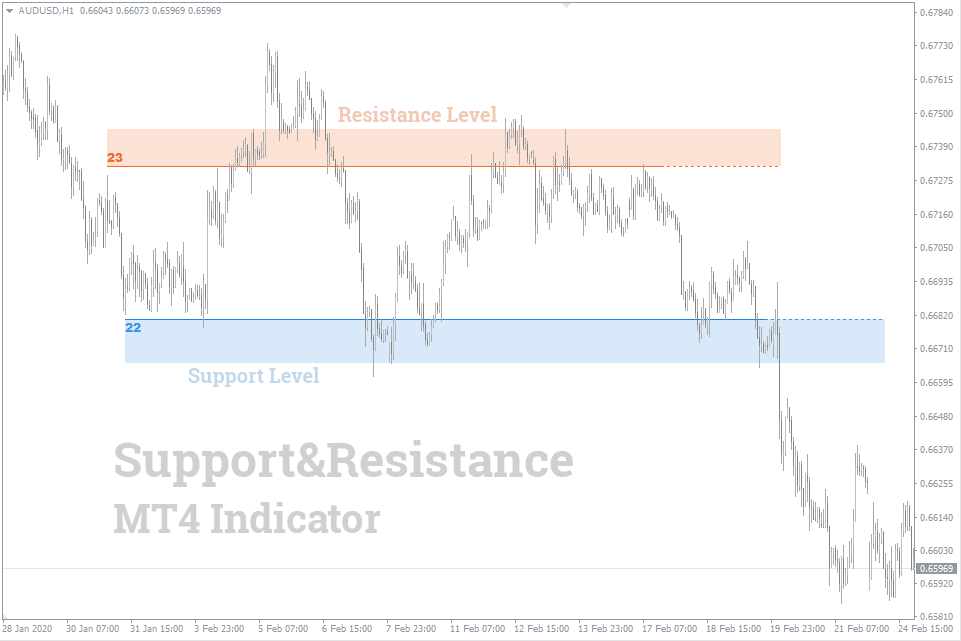
This is probably one of the best indicators of this kind available in the marketplace that ensures the well-nigh accurate drawing of support and resistance levels. If you commencement using it, you'll significantly increase your chances of making a profit in the Forex market place.


Source: https://fxssi.com/support-and-resistance-levels-how-to-define
Posted by: torresthereenewhe.blogspot.com
0 Response to "How To Draw Proper Support And Resistance Zones"
Post a Comment